Decoction
9–15 g of peeled root in water, at a gentle simmer. Taken in divided doses through the day, following traditional Chinese practice.

 Zoom
Medicinal & Therapeutic Herbs
Astragalus membranaceus (Fisch.) Bunge
Also known as: Huang qi, Chinese astragalus. In English: Astragalus, Milk Vetch, Huang Qi.
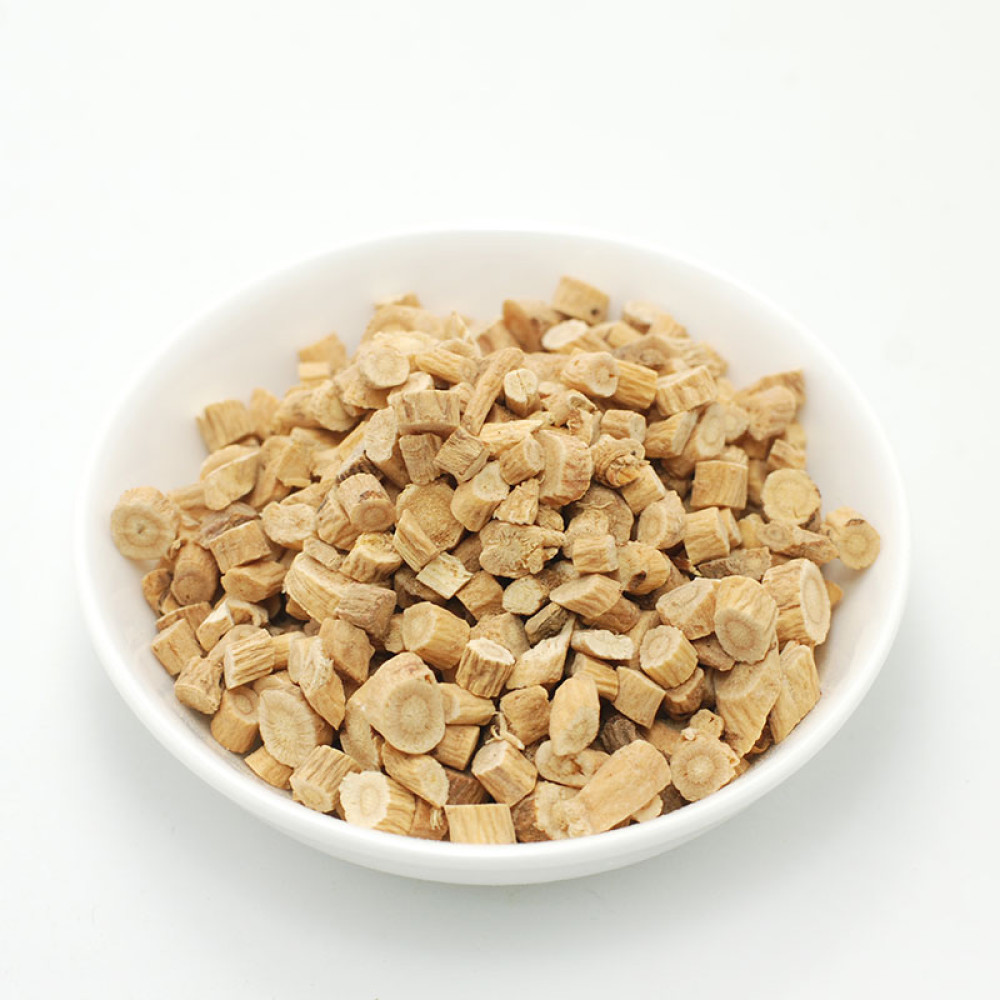
Astragalus is a perennial legume native to northern China, chiefly the provinces of Yunnan and Sichuan. The genus runs to more than 2,000 species worldwide, but pharmacological work has focused on the Chinese Astragalus membranaceus. The dried root is the part used.
Send us a message and we reply within one working day. Or call us on (+30) 2610 221354 during shop hours.
Send a message(+30) 2610 221354Astragalus is a perennial legume native to northern China, chiefly the provinces of Yunnan and Sichuan. The genus runs to more than 2,000 species worldwide, but pharmacological work has focused on the Chinese Astragalus membranaceus. The dried root is the part used.
The root is naturally rich in polysaccharides (APS), flavonoids, triterpene saponins (astragalosides) and amino acids. Chinese tradition describes it as tonic, strengthening to stamina and supportive of the immune system, and places it among the herbs that build "qi".
Traditionally associated with the immune system, fatigue, stamina and periods of depletion or convalescence.
In traditional Chinese medicine astragalus is regarded as a foundational tonic and taken in courses, particularly through winter. Its polysaccharides have been the subject of laboratory research in relation to immune function.
Beyond the infusion, in China slices of the root go into soups and stews and cook alongside the food — one of the oldest forms of its use.
9–15 g of peeled root in water, at a gentle simmer. Taken in divided doses through the day, following traditional Chinese practice.
Pieces of root are added to soups, broths and stews and lifted out before serving, like a bay leaf.
Quantities are indicative and based on traditional use and published herbal literature. For prolonged use, or if you are on medication, consult a healthcare professional.
Chinese tradition pairs it classically with ginseng and codonopsis as a tonic, with ginger and liquorice in broths, and with goji in winter drinks.
Both are considered tonics in Chinese tradition, but astragalus is described as gentler and better suited to long term use, while ginseng is regarded as more stimulating.
It needs a gentle simmer rather than a simple infusion. The root is hard and releases its constituents slowly.
Yes. In China the slices are cooked in soups and broths and removed before serving.
Have you tried Astragalus membranaceus root? Tell us what you think.
4.25€50 g · 3 weights
1.05€50 g · 3 weights
2.55€50 g · 3 weights
2.20€50 g · 3 weights