Could Your Hormones Be the Reason You're Not Losing Weight?

Could your hormones be the reason you're not losing weight?
You watch what you eat and you exercise, yet despite all your efforts the scales won't budge? Doctors say they know why this happens, and it seems to come down to your hormones and how well you "manage" them.
By Lynne McTaggart
A few years ago, a team of Spanish doctors brought together 105 overweight men and women aged 20 to 30 and put them on a calorie-restricted diet for eight weeks. On the whole, the diet worked: participants lost around 5% of their body weight on average, so someone weighing 100 kg lost about 5 kg. Four months later, the researchers saw the participants again to check whether their weight had stayed stable.
Some of the participants had put the weight back on, but the researchers also found an important clue as to why this so-called "yo-yo effect" had happened. These people shared a physical trait: it wasn't simply the food they were eating; for the most part, it was their hormones.
In these participants, the body's "fat thermostats" had gone out of balance and were no longer giving the brain the right information about food (J Clin Endocrinol Metab, 2010; 95: 5037–44).
What the Spanish researchers found in those who had regained weight was higher levels of a hormone called leptin and lower levels of another hormone called ghrelin. This led them to conclude that these appetite-related hormones may play an important role in regaining weight after a diet.
The hormones leptin and ghrelin
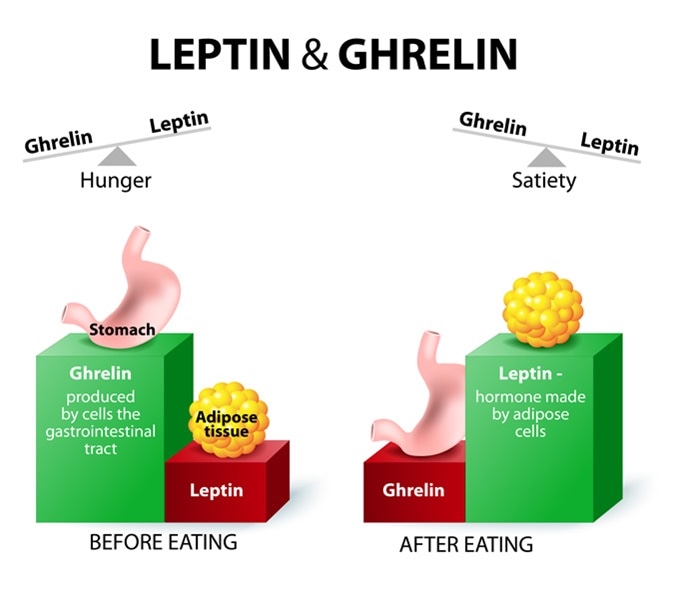
Both hormones, discovered in the 1990s, regulate appetite and fat levels. Leptin is produced in fat cells, the cells where fat is stored. It is a protein hormone that circulates in the blood, telling the brain how much "fuel" the body has and whether it is getting enough energy.
Every time you finish a meal, leptin is released from your fat stores into the bloodstream and eventually reaches the brain, carrying the message that you are full and that you have a certain amount of energy in reserve.
In fact, leptin could more accurately be called a fat regulator than a thermostat. It tells the brain whether you are hungry and how much fat there is in your body, just as the fuel gauge in your car shows you how much petrol is left in the tank.
According to Robert Lustig, professor of paediatrics at the University of California, San Francisco, and an obesity expert, leptin is the hormone that tells the brain about the body's energy reserves: when its levels fall, the brain gets the message that it needs to eat more.
As leptin levels rise, your appetite gradually decreases and you feel full. At the same time, your metabolic rate goes up. Your brain "understands" that there is enough food and fat for the body's functions, and this in turn brings leptin levels back to normal. At that point, food loses its appeal and no longer seems so tasty, and the brain receives the signal that you have eaten enough.
This process also keeps your metabolism at normal levels, lets you eat normal amounts of food and allows the body to cope with complex, energy-hungry processes such as puberty and pregnancy.
When you are on a weight-loss diet, your body naturally produces less leptin. So when leptin levels fall below a certain point, the brain "thinks" you are starving and sets off a series of processes to restore energy homeostasis (balance). One of its main responses is to stimulate the vagus nerve, the nerve that runs from the brain to the abdomen and governs energy storage, which increases your appetite.
During a diet, we are often in a state of leptin deficiency. In a small study, researchers using functional magnetic resonance imaging (fMRI) showed that obese volunteers who had lost 10% of their body weight also had changes in neural activity throughout the brain when shown pictures of food, which the researchers attributed to leptin deficiency (J Clin Invest, 2008; 118: 2583–91).
Leptin also regulates the rate at which fat is broken down. As leptin levels rise, so does the rate of fat metabolism. When food intake falls, and with it leptin levels, the metabolic rate falls too. This is often why dieters reach a point after which they find it hard to lose weight: the body believes it is starving and goes into a kind of emergency alert, slowing down all its normal processes to save whatever energy it has.
Besides leptin, another important hormone for fat regulation is ghrelin. This peptide stimulates the release of growth hormone and increases the amount of fat in the body. That is where its name comes from: "ghre" is an Indo-European root meaning "grow", and it was apparently chosen by the Japanese researchers who discovered it because of its role as a growth hormone-releasing peptide.
The opposite of leptin
Ghrelin is produced in the lining cells of the stomach and is the opposite of leptin: its levels rise before meals and fall after them. Ghrelin acts on a receptor in the pituitary gland (the gland at the base of the brain, near the hypothalamus) and triggers the release of growth hormone from the front lobe of the pituitary to promote growth.
So ghrelin stimulates the release of growth hormone by acting directly on the pituitary, but it also affects several areas of the nervous system within the hypothalamus that are involved in appetite control.
It therefore seems to be involved in regulating the body's energy. Indeed, the higher our ghrelin levels, the hungrier we feel. Ghrelin levels peak before meals and drop sharply afterwards.
Although scientists have known about the role of growth hormone for 25 years, ghrelin was only discovered in the late 1990s and its physiological role is still not fully understood. In a study in laboratory animals given ghrelin by injection, their feeding behaviour was stimulated and their body weight increased (Nature, 2001; 409: 194–8).
So although we know that ghrelin plays an important role in regulating growth, by stimulating the urge to eat and the release of growth hormone, the exact nature of its role remains unknown.
In a small clinical study, researchers gave nine healthy volunteers ghrelin by intravenous infusion and asked them to choose food from a buffet. The experiment was then repeated, but this time a saline solution was infused instead. The results showed that the volunteers ate clearly more after ghrelin than after saline, and they also scored higher on appetite tests (J Clin Endocrinol Metab, 2001; 86: 5992).
Scientists have also observed that people with long-term obesity have much lower ghrelin levels than people of normal weight. What's more, ghrelin levels appear to be linked to circadian rhythms, which are disrupted in people with obesity (Proc Natl Acad Sci U S A, 2004; 101: 10434–9). Indeed, chronic lack of sleep increases ghrelin production and therefore also stimulates appetite.
However, there seems to be a subtle and perhaps even competing interaction between ghrelin and leptin in regulating appetite, which we still don't fully understand. For example, in the animal experiment mentioned above, ghrelin also blocked the reduction in food intake caused by leptin (Nature, 2001; 409: 194–8).
Leptin resistance
Overweight people, like those in the Spanish study who regained the weight they had lost, have a problem known as "leptin resistance". Just as in the "insulin resistance" of type 2 diabetes, where the pancreas produces large amounts of insulin that the body no longer responds to properly, leptin resistance occurs when the brain no longer recognises raised leptin levels.
In this situation, there is plenty of leptin and stored fat, but the brain believes leptin levels are low. So it "thinks" the body is starving and sets off processes that create a feeling of hunger, regardless of how much fat is stored. On top of that, food seems even tastier than usual, so we eat much more.
In the Spanish study, those who regained weight after the diet had blood leptin levels that stayed higher than those of the other participants. Interestingly, however, they did not have higher insulin levels, which suggests that it is leptin resistance, rather than insulin resistance, that contributes to weight gain.
Scientists at Harvard Medical School discovered that leptin resistance is linked to the endoplasmic reticulum of the cells. According to Umut Özcan, a researcher at Boston Children's Hospital, when proteins are not folded properly inside the cell (a condition known as endoplasmic reticulum stress), the brain does not respond to the leptin signal.
In earlier research, Özcan had found that endoplasmic reticulum stress is linked to type 2 diabetes and insulin resistance. In studies, mice fed a high-fat diet developed signs of endoplasmic reticulum stress in the hypothalamus, the main area of the brain that receives the leptin signal (Science, 2004; 306: 457–61).
In another study by Özcan and his team, a protein was removed from the hypothalamus of normal mice. Endoplasmic reticulum function was disrupted and the mice developed endoplasmic reticulum stress, became severely leptin resistant and grew obese when fed a high-fat diet (Cell Metabolism, 2009; 9: 35–51). As Özcan puts it: "Most people who are obese have leptin resistance. Leptin goes to the brain and knocks on the door, but inside, the person is deaf."
According to Tamas Horvath, a neuroscientist at Yale University who studies the role of leptin in the brain, the endoplasmic reticulum is the cell's main "building site". Increased leptin signalling is like architectural instructions for "over-building", so the endoplasmic reticulum eventually becomes overloaded because it has too many jobs to do at once.
Leptin also plays an important role in maintaining adequate fat levels in the female body, which may mean that women are more prone to leptin resistance. Indeed, in the Spanish study, more women than men among those who regained weight had high leptin levels. Medicine now believes that women need adequate leptin levels to maintain fertility.
Leptin also plays an important role in the onset of puberty (Pediatrics, 2008; 121: S208–17), while abnormal levels may be linked to type 1 diabetes (J Clin Endocrinol Metab, 2001; 86: 1188–93).
Disrupted leptin signalling is also linked to chronic inflammation in the body, which may eventually lead to cardiovascular disease and many other problems. Together with obesity, it is also considered a predictor of insulin resistance in children (Int J Obes Relat Metab Disord, 2000; 24: 1265–71).

Low ghrelin levels
As with leptin, ghrelin levels are disrupted in people with obesity. One study found that blood ghrelin levels were lower in people with long-term obesity from two culturally different populations, compared with people of normal weight. This suggests that ghrelin is lower in obesity, probably because of higher-than-normal insulin and leptin levels. For this reason, the researchers argue that these lower levels may be a kind of physiological "adaptation" of the body to a constant oversupply of energy from overeating (Diabetes, 2001; 50: 707–9).
When you diet, the body often produces more ghrelin than usual, because it "thinks" it is starving and tries to regain the weight it has lost. In one study, people who had dieted were compared with people who had had gastric bypass surgery. The results showed that the surgery group had significantly lower ghrelin levels, which probably contributed to their weight loss after the operation (N Engl J Med, 2002; 346: 1623–30).
However, the link between ghrelin and obesity is not simple. In the Spanish study, those who initially lost weight showed no changes in ghrelin, but those who regained their weight had lower ghrelin levels than the others.
What's more, men had the biggest changes in ghrelin levels, which suggests that this hormone plays a bigger role in appetite control in men than in women.
Although leptin supplements are sold online as magic weight-loss pills, leptin cannot be taken by mouth as a supplement, because it is a protein and will simply be broken down by the body, just like when you eat a piece of chicken. In fact, most "leptin" supplements contain various other ingredients known for stimulating the thyroid or leptin production, or for creating a feeling of fullness, such as soluble fibre.
For a time, the hope was that leptin could be regulated simply by taking a pill. However, the latest evidence shows that both leptin and leptin resistance are influenced by lifestyle: in other words, by what you eat, how much you exercise, how well you sleep and whether you can keep everyday stress under control. Even more importantly, leptin resistance is linked to inflammation, which in turn can be driven by an unhealthy lifestyle and a long-term lack of omega-3 fatty acids.
Ultimately, the interplay between leptin, ghrelin, insulin and other regulatory hormones in the body is extremely complex. This suggests that gaining and losing weight is far more complicated than simply counting calories, burning energy or taking a slimming pill. The best approach, as always, is a holistic one: we look after the body as a single, interconnected whole and give it the best possible food, exercise and rest. This gives the body the best chance of reaching and keeping a healthy weight.
In search of an artificial fat regulator
After leptin was discovered in 1994, the pharmaceutical industry and academic centres were convinced they had found the answer to obesity: simply give people extra leptin. But these hopes were soon dashed when it became clear that overweight people tend to have leptin resistance. Those who were given the hormone lost weight only temporarily and soon went back to their old weight, because the brain had got used to the higher hormone levels and was ignoring them again.
Researchers are now looking for ways to get around leptin resistance chemically. Scientists at Harvard Medical School showed that two substances, 4-phenylbutyric acid (4-PBA, also known as Buphenyl) and tauroursodeoxycholic acid (TUDCA), can stop the brain from ignoring leptin. Both are already used in medicine: the first for rare metabolic disorders (of the urea cycle) and the second for liver conditions.
In the study, when Dr Özcan and his team gave mice 4-PBA or TUDCA, their sensitivity to leptin increased tenfold and the mice lost significant weight, even on a high-fat diet (Cell Metabolism, 2009; 9: 35–51). As Özcan reported, this was the first study to show that leptin sensitivity could be restored in mice, even though they were being fed a lot of fat.
The 4-PBA and TUDCA molecules are known as "chemical chaperones": they help the cell's endoplasmic reticulum fold proteins properly. However, apart from the fact that this research was only done in animals and may not apply to humans, the real problem is that we don't yet understand the exact mechanism behind endoplasmic reticulum stress in overweight people who eat a high-fat diet.
Özcan's team is still working to understand leptin sensitivity more precisely, in order to develop a drug that restores leptin signalling in the brain more effectively than these two substances.
Meanwhile, scientists at the Scripps Research Institute in La Jolla, California, have developed an anti-obesity vaccine that targets ghrelin: it prompts the body to make antibodies that bind to ghrelin, triggering an immune response against it. In theory at least, this stops ghrelin from reaching the central nervous system and "tricks" the brain (and so the body) into feeling full. So far, the vaccine has been tested successfully in rats, but not in humans (Proc Natl Acad Sci U S A, 2006; 103: 13226–31).
Amylin Pharmaceuticals in San Diego carried out clinical trials combining leptin with a drug that increases sensitivity to it.
However, Tamas Horvath of Yale University believes that this kind of artificial intervention could be disastrous, as it might simply encourage cells to keep on growing. Besides, he says, it isn't necessary, since there are many other proven ways to restore leptin function (see below).
What you can do

Burn fat in your sleep
As a society, not only are we heavier than ever, with obesity rates rising alarmingly, but we also sleep much less. Indeed, the proportion of young adults who sleep 8 to 9 hours a night has almost halved. What's more, other evidence has shown that lack of sleep affects blood levels of leptin and ghrelin, as well as hunger and appetite (Ann Intern Med, 2004; 141: 846–50).
According to recent Canadian research, these two pairs of factors are now thought to be linked. A six-year study from Quebec of 323 men and 417 women aged 21 to 64 showed that the less we sleep each night, the higher our body fat measures and the lower our leptin levels. Those who reported sleeping seven to eight hours had significantly higher leptin levels and lower body fat measures than those who managed only five to six hours a night.
The researchers concluded that short sleep may increase the risk of weight gain because of lower leptin levels. There is an optimal number of hours of sleep at which body weight is regulated and kept stable (Obesity (Silver Spring), 2007; 15: 253–61). It is suggested that seven to eight hours of sleep, no more and no less, will not only keep you alert but also help regulate your weight.
Switch on your "fat burners"
Although leptin supplements have been shown not to work, you can support the hormones that regulate fat with a number of important lifestyle choices:
- Choose a diet rich in fresh organic foods, made up mostly of colourful, highly nutritious fruit, vegetables and herbs.
- Aim to eat 9 or 10 portions of fruit and vegetables every day, says Dr Leo Galland, author of The Fat Resistance Diet (Broadway Books, 2005).
- Vegetables that support fat regulation include cruciferous vegetables such as broccoli and cabbage, as well as carrots, leeks, onions, spring onions, garlic, asparagus, peppers, rocket and lettuce, spinach and tomatoes.
- Fruits often recommended in weight-management diets include bananas, apples, berries, cherries, oranges, grapefruit and pomegranates.
- Herbs traditionally appreciated in weight-management routines include ginger, ginseng, cinnamon, bilberry, chamomile, chaste tree, green tea, peppermint oil, turmeric, dandelion, aloe vera and echinacea.
- Use spices in your cooking.
- Add fresh, raw, unsalted nuts and seeds to your diet, such as walnuts, linseed, sesame and almonds.
- Make sure you get enough omega-3 fatty acids. The best sources are oily fish such as sardines, salmon and tuna, as well as walnuts, linseed and pulses (such as soya and beans).
- Exercise regularly, enough to work up a sweat. Regular aerobic exercise helps improve leptin sensitivity, especially combined with a healthy diet.
- Choose grains with a lower glycaemic index (GI), such as pasta, brown rice, quinoa, millet, oats and barley.
- Cut out or cut down on refined sugar in all its forms.
- Watch your carbohydrate intake and limit processed and high-GI foods such as white bread, potatoes, white rice, sweets, cakes and beer.
- Consider good-quality supplements rich in B vitamins, especially B12, as well as omega-3 fatty acids, magnesium, zinc and coenzyme Q10, which is studied for its anti-inflammatory potential. If you take any medication, check with your pharmacist or doctor first.
- Avoid low-calorie "diet" foods, especially artificial sweeteners and soft drinks, which, according to some evidence, may slow down weight loss (JAMA, 2009; 302: 2477–8).
- Eat three good meals a day and don't snack.
- Don't eat late at night.
- Include protein in your breakfast.
- Sleep 7 to 8 hours a night, no more and no less.
- Drink plenty of water, green and black tea, blackberry, cherry and pomegranate juices, and vegetable juices.
Article source: holisticlife.gr (in Greek)