Free shipping in Greece over €49 (first 3 kg)

Shipping to the EU · free over €200 (first 2 kg)

Organic Supplements

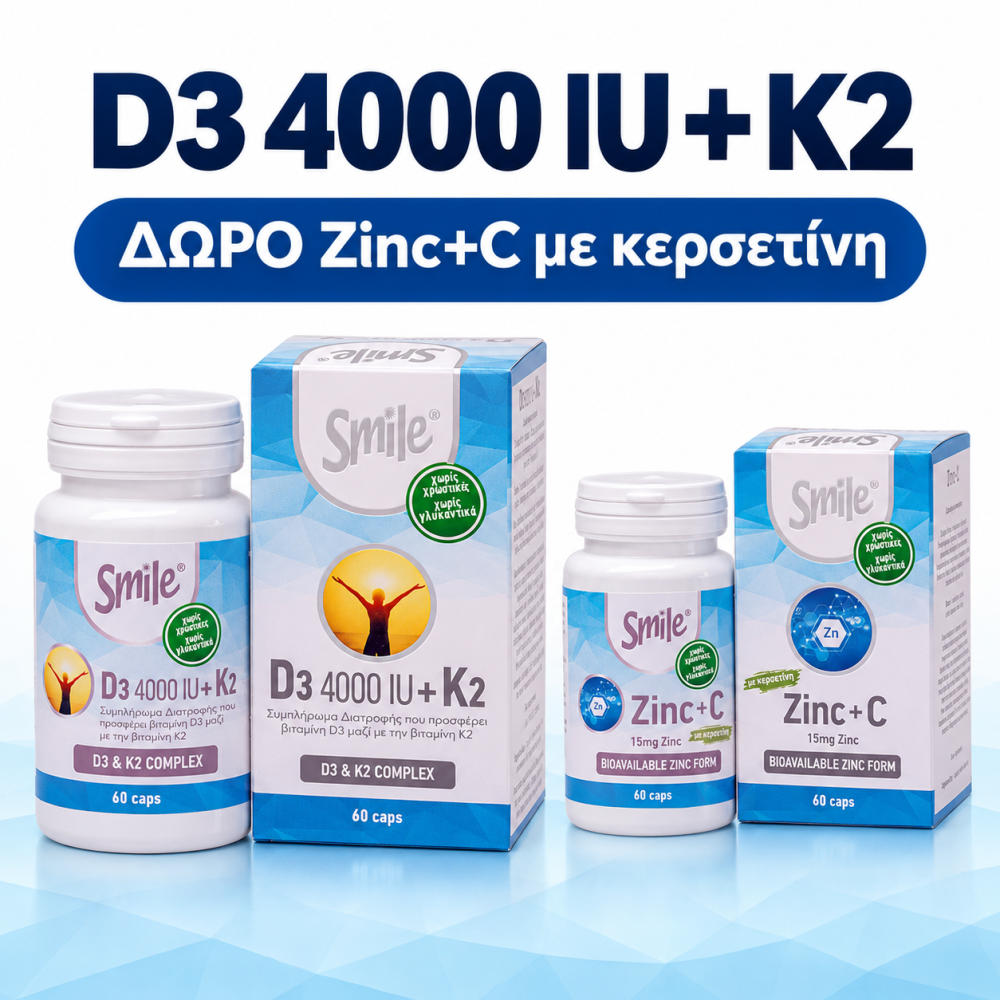
Vitamin D3 4000 IU + K2 100 mcg Smile, 60 capsules + Free Zinc & Vitamin C 60 capsules

Smile D3 4000 IU + K2 is a food supplement that provides, in one capsule a day, 4000 IU (100 mcg) of vitamin D3 and 100 mcg of vitamin K2 as MK-7. The two vitamins work together in the way the body handles calcium, which is why they are increasingly taken as a pair.

See the full description ↓

Write the first review Code: SMILE-003b
16.30€ 24.90€ Price includes VAT

In stockShips by courier in 1–2 working days

Shipping options

  • EU countries: DHL from €18 · free over €200 (first 2 kg, by volumetric weight)
  • Cyprus: ACS, BOX NOW or DHL · free with ACS or BOX NOW over €99
  • Greece: ACS or ELTA to your door from €4.00 · ACS or BOX NOW lockers from €2.40 · free over €49 (first 3 kg)
  • Usually dispatched within 1–2 business days

Everything about shipping and delivery →

Payment methods

  • Card, Google Pay, Apple Pay, with no extra charge
  • Cash on delivery (Cyprus and Greece): ACS +€2.50 · ELTA +€3.50
  • IRIS or bank transfer (Greece only)

Everything about payment methods →

Have a question about Vitamin D3 4000 IU + K2 100 mcg Smile?

Send us a message and we reply within one working day. Or call us on (+30) 2610 221354 during shop hours.

Send a message(+30) 2610 221354

What it is

Smile D3 4000 IU + K2 is a food supplement that provides, in one capsule a day, 4000 IU (100 mcg) of vitamin D3 and 100 mcg of vitamin K2 as MK-7. The two vitamins work together in the way the body handles calcium, which is why they are increasingly taken as a pair.

Vitamin D is a fat-soluble vitamin that comes in two forms, D2 and D3 (cholecalciferol). D3 is the form our own body makes, and it raises blood levels of the vitamin more effectively.

In the body, vitamin D acts like a steroid hormone. Most cells carry receptors for its metabolites, so it takes part in many functions, including the maintenance of normal bones and teeth and the normal function of the immune system and muscles. Its relationship with mental health and mood is also being studied.

Key benefits

  • Bones and teeth: vitamin D contributes to the normal absorption and utilisation of calcium and phosphorus and to the maintenance of normal bones and teeth. Vitamin K also contributes to the maintenance of normal bones.
  • Immune system: vitamin D contributes to the normal function of the immune system.
  • Muscles: vitamin D contributes to the maintenance of normal muscle function.
  • Blood clotting: vitamin K contributes to normal blood clotting.
  • Easy to take: one capsule a day, with a plant-based capsule shell, free from colourings, flavourings and sweeteners.

Uses

It is usually chosen by:

  • people who spend most of their day indoors
  • people who routinely cover up from the sun
  • older adults
  • people with darker skin
  • people who rarely eat oily fish

as well as by those who want D3 and K2 together in one capsule.

How D3 and K2 work together

Vitamin D3 increases the absorption of calcium from the gut and the production of proteins that handle calcium, such as osteocalcin and matrix Gla protein (MGP). To work, these proteins must first be activated by vitamin K.

Osteocalcin helps bind calcium into bone tissue. MGP is being researched for its role in preventing calcium from building up in artery walls and other soft tissues. This is why D3 and K2 are seen as a complementary pair: the first increases the calcium we absorb, and the second takes part in where it ends up.

K2 in the MK-7 form stays in the blood longer than other forms of vitamin K, so one dose a day is enough.

Why vitamin D deficiency is common even in Greece

The skin makes up to 90% of the vitamin D we need, using the sun's ultraviolet light, mainly around midday from spring to autumn. Food provides smaller amounts, mostly from oily fish and eggs.

You would expect deficiency to be rare in a sunny country. Measurements show the opposite, something researchers call the "Mediterranean paradox":

  • A 2017 systematic review, with data from 107 studies in Southern Europe and the Eastern Mediterranean, found a high prevalence of low vitamin D status despite abundant sunshine. Other surveys often show better levels in Northern than in Southern Europe.
  • In a study in Valencia, Spain, of 169 children with a median age of 9 months, about one in four children under 2 had levels below 30 ng/mL. The researchers stressed the importance of prevention in the first years of life, even in sunny Mediterranean regions.
  • In a study by the Aristotle University of Thessaloniki and St George's University of London Medical School at the University of Nicosia, with data from 8,780 Greek and 2,594 Cypriot individuals, 73% of the Greek and 69% of the Cypriot participants had inadequate vitamin D levels (below 30 ng/mL).

Possible reasons:

  • Less sun exposure than we think: in sunny countries people avoid the hottest hours and cover up with clothes, hats and sunscreen more than people in less sunny countries. Indoor work reduces exposure further, and in winter skin production drops sharply.
  • Diet: despite being surrounded by sea, Greeks eat oily fish less often than one might think. In Sweden and Norway, higher levels are strongly associated with eating oily fish and fish oils.
  • Darker skin: melanin acts as a natural filter against sunlight, so people with darker skin make less vitamin D from the same exposure.
  • Pregnancy: low levels are also common in pregnant women in the Mediterranean, which affects the newborn's levels too.

Sunshine alone, then, does not guarantee good vitamin D levels. A simple blood test, 25(OH)D, tells you where you stand.

Vitamin K1 and K2

Vitamin K was discovered in 1929 as an essential factor in blood clotting. It has two main forms:

  • Vitamin K1 (phylloquinone): found mainly in green leafy vegetables, with a central role in blood clotting.
  • Vitamin K2 (menaquinone): found in animal foods such as eggs, full-fat dairy and butter, and in fermented foods such as cheese, yoghurt and natto (fermented soybeans). Its main forms are MK-4 and MK-7. Some is also made by gut bacteria.

If you rarely eat these foods, a supplement is an easy way to get K2, and taking it with D3 makes use of how the two vitamins work together.

Composition

IngredientPer capsule% NRV*
Vitamin D3 (cholecalciferol)4000 IU (100 mcg)2000%
Vitamin K2 (MK-7)100 mcg–

Other ingredients: rice flour (Oryza sativa), plant-based capsule shell made of hydroxypropyl methylcellulose (HPMC).

Contains no colourings, flavourings or sweeteners.

*NRV: Nutrient Reference Value.

Notified to the Greek National Organization for Medicines (EOF) under no. 87098/03.07.2026. The notification number does not constitute a licence.

How to use & dosage

Adults

1 capsule a day with food, or as directed by your doctor.

Vitamins D and K are fat-soluble and are better absorbed with a meal that contains some fat, such as olive oil, eggs, yoghurt or nuts.

Precautions & storage

  • Dosage: do not exceed the recommended daily dose.
  • Diet: food supplements should not be used as a substitute for a varied, balanced diet.
  • Anticoagulants: people on anticoagulant treatment who wish to take 100 mcg of vitamin K or more should consult their doctor first.
  • Storage: keep in a cool, dry place.

Frequently asked questions

Why take D3 and K2 together?

D3 increases calcium absorption and K2 activates the proteins that handle calcium in the body. Both vitamins contribute to the maintenance of normal bones, which is why this is one of the most popular combinations.

Is 4000 IU a high dose?

4000 IU (100 mcg) is the tolerable upper intake level for adults set by the European Food Safety Authority (EFSA), from all sources combined. That is why this capsule is for adults and should not be combined with other vitamin D supplements unless your doctor advises it.

When is the best time to take it?

With your main meal or any meal that contains some fat, since vitamins D and K are fat-soluble. Taking it regularly matters more than the time of day.

Do I need vitamin D if I live somewhere sunny?

Sunshine alone does not guarantee good levels. In a Greek-Cypriot study, more than 7 in 10 Greek participants had inadequate vitamin D levels. A 25(OH)D blood test shows where you stand.

What is MK-7?

It is a form of vitamin K2 found mainly in natto, fermented soybeans. It stays in the body longer than other forms, so one capsule a day is enough.

Can I take it if I am on anticoagulants?

Vitamin K affects blood clotting. People on anticoagulant treatment should consult their doctor before taking it.

Indicative bibliography:
  • Manios Y. et al. A systematic review of vitamin D status in southern European countries. European Journal of Nutrition, 2018;57(6):2001–2036.
  • Xyda S.E. et al. Could the majority of the Greek and Cypriot population be vitamin D deficient? Nutrients, 2022;14(18):3778.
  • Is there vitamin D deficiency in children in a sunny Mediterranean city? Anales de Pediatría (Barcelona), 2016;84(3):163–169.
  • EFSA NDA Panel. Scientific opinion on the tolerable upper intake level for vitamin D. EFSA Journal, 2023;21(8):8145.

Reviews

No reviews yet

Have you tried Vitamin D3 4000 IU + K2 100 mcg Smile? Tell us what you think.

From the same category
You may also like

WELCOME GIFT

The herb guide

260 herbs arranged by need — to start your journey into wellbeing.

when you sign up with your email