Not suitable for self-treatment
No dose is provided for tea, tincture or another internal preparation. Rue has a narrow safety margin and a history of abortifacient use; this information is a safety warning, not a use instruction.

 Zoom
Medicinal & Therapeutic Herbs
Ruta graveolens L.
Also known as: Rue, Herb-of-Grace, Garden Rue.
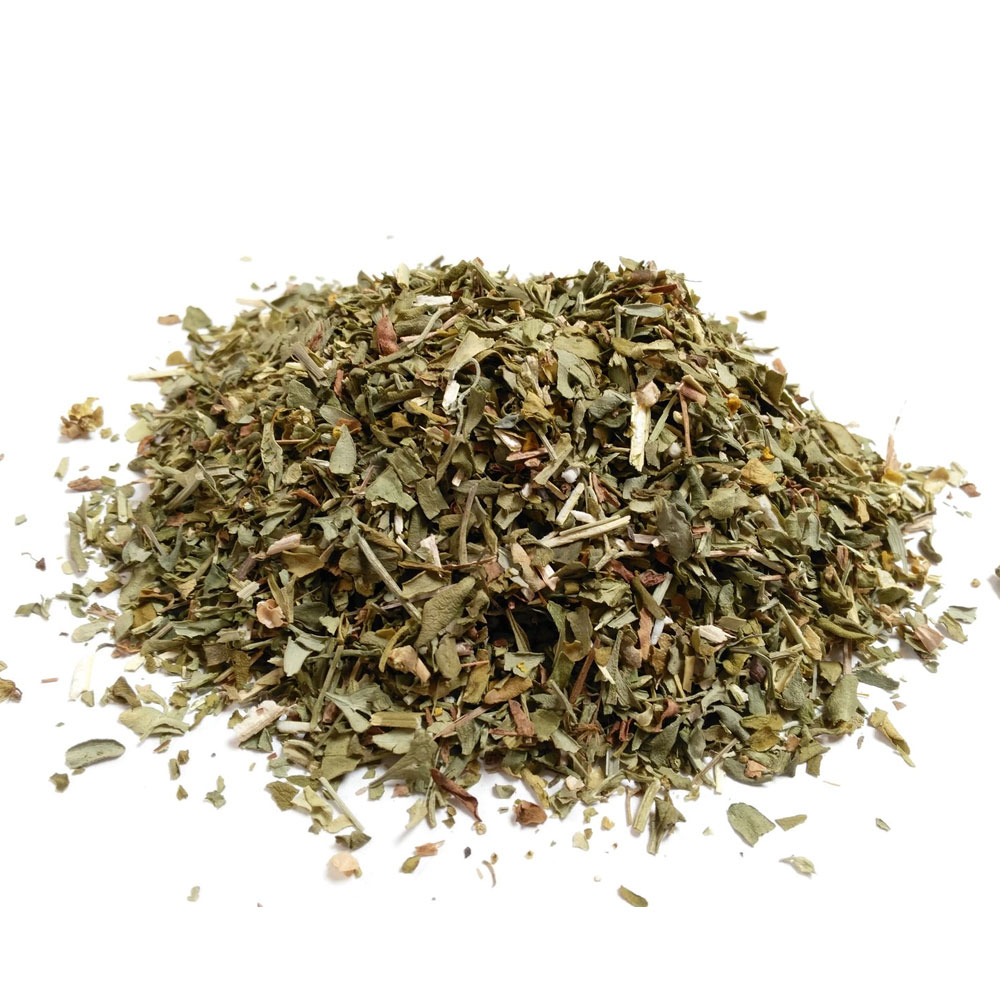
Common rue is a perennial aromatic plant of the rue family, with blue-green leaves and yellow flowers. Native to Southern Europe and the Mediterranean. Traditionally used for digestive spasms and states of nervous hyperexcitability.
Send us a message and we reply within one working day. Or call us on (+30) 2610 221354 during shop hours.
Send a message(+30) 2610 221354Common rue is a perennial aromatic plant of the rue family, with blue-green leaves and yellow flowers. Native to Southern Europe and the Mediterranean. Traditionally used for digestive spasms and states of nervous hyperexcitability. Has a long history in Greek folk tradition — often planted in courtyards as a plant that "wards off evil".
Rue is naturally rich in bitter compounds (rutin, quercetin), essential oil and alkaloids (furanocoumarins). Due to these active compounds, it is considered a potent herb requiring specialised knowledge.
In traditional European and Mediterranean phytotherapy, rue is recorded for:
and as an antispasmodic.
In aromatherapy it is used externally in very small concentrations. Older folk sources additionally mention epilepsy, poisoning and eye complaints, and an external rue oil for painful haemorrhoids. Because of toxicity and the sensitivity of the area, these remain historical references requiring specialist guidance.
In cooking it appears in tiny quantities in Southern European recipes, such as grappa alla ruta in Italy.
No dose is provided for tea, tincture or another internal preparation. Rue has a narrow safety margin and a history of abortifacient use; this information is a safety warning, not a use instruction.
Avoid internal use unless explicitly directed by a suitably qualified healthcare professional.
Because of its toxicity and narrow safety margin, combinations for self-treatment are not recommended.
No. Self-treatment and daily internal use are not recommended because rue has a narrow safety margin.
It is included solely as a serious safety warning. Rue is absolutely contraindicated in pregnancy and is not presented as a permitted use.
In folk tradition it is viewed as a protective plant against the evil eye. This is cultural history, not a pharmacological property.
Have you tried Rue herb? Tell us what you think.
3.10€50 g · 3 weights
2.95€50 g · 3 weights
2.10€50 g · 3 weights
0.80€50 g · 3 weights